
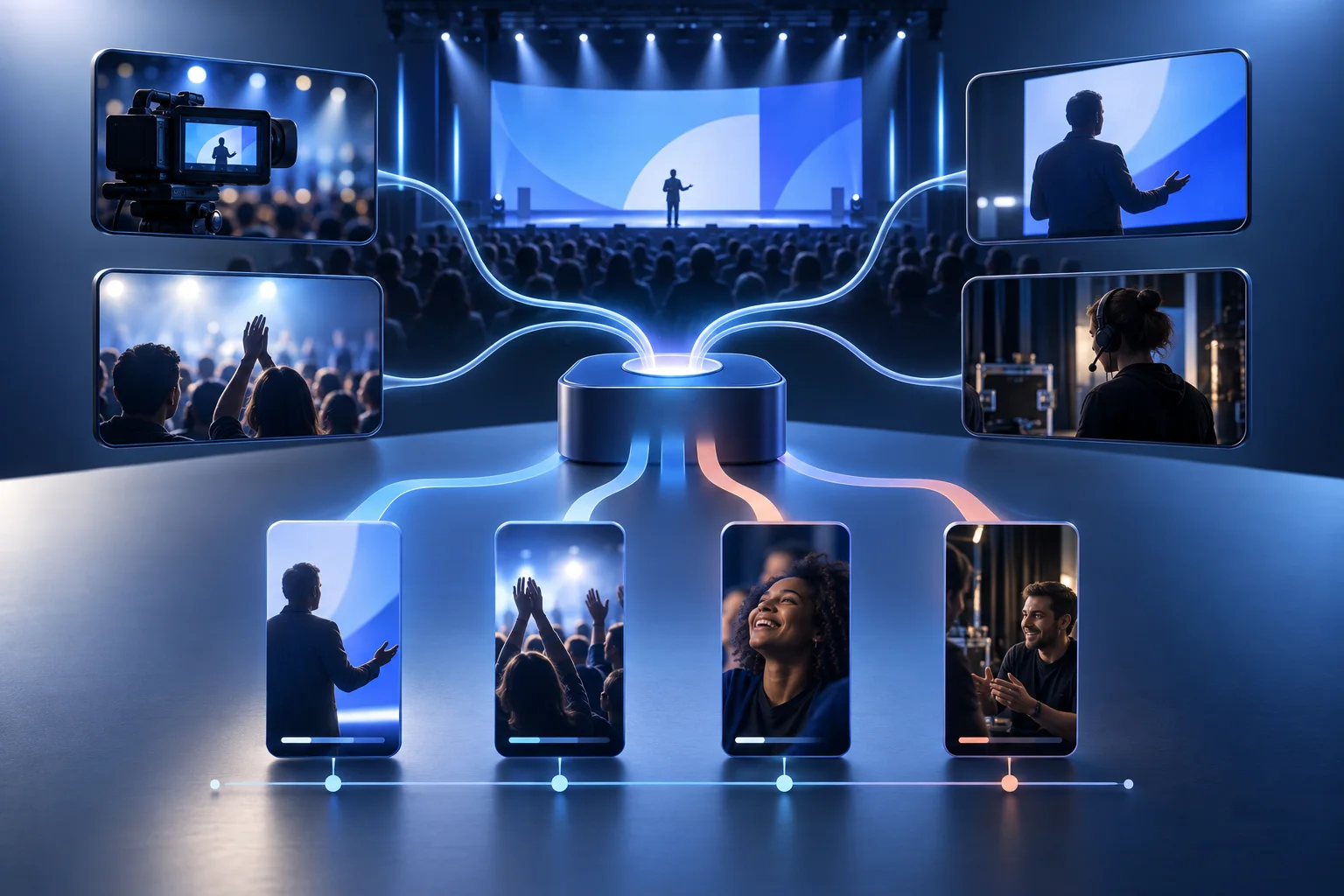
The short answer
Plan derivative rights and capture before the event. Record clean stage audio, audience reaction, b-roll, screens, interviews, and identifying context. During and after the event, separate fast-turnaround recaps from evergreen insights. Verify speakers, claims, releases, and music; then publish a paced sequence of timely highlights, lessons, proof, and follow-up actions.
The before, during, and after event system
Capture decisions before the doors open determine what the team can repurpose afterward.
Plan rights and outputs
Define speaker, attendee, venue, music, sponsor, and slide permissions.
Capture clean evidence
Record isolated audio, legible screens, stable stage shots, audience atmosphere, and vertical b-roll.
Log moments live
Mark announcements, quotes, demonstrations, reactions, and questions with timestamps.
Run a fast factual review
Confirm names, roles, claims, and embargoes before timely clips publish.
Separate timely and evergreen
Use immediate recap quickly; hold deeper lessons for careful editing.
Build the follow-up arc
Sequence highlights, insights, proof, objections, community response, and next action.
Make the important decisions before editing
Speed matters only after rights and facts are clear.
| Signal | Decision | Why it matters |
|---|---|---|
| Breaking announcement | Use the fast lane with named approval | Freshness has value and risk. |
| Evergreen keynote lesson | Edit for context and longevity | It can support a longer follow-up window. |
| Audience member identifiable | Confirm permission or avoid the shot | Attendance is not blanket promotional consent. |
| Licensed walk-on music audible | Replace or clear it | Venue playback rights may not cover social reuse. |
Put the method into a real production cycle
Begin with plan rights and outputs, then keep the work traceable until build the follow-up arc is complete.
Use one representative source or campaign first. Record the current version, owner, evidence, and intended destination before the work moves. At every handoff, ask whether the next person is receiving a decision-ready item or an unresolved problem. That distinction keeps a repeatable workflow from becoming a chain of hidden assumptions.
Run the decision table against at least one normal case and one difficult case. The difficult case should include the condition “licensed walk-on music audible.” If the process cannot route that exception safely, fix the ownership or hold state before increasing volume. Scale only after the team can reproduce the quality bar and explain why a piece passed.
After the first cycle, review rejected work as carefully as published work. Rejections reveal unclear source requirements, missing evidence, weak boundaries, and ownership gaps. Turn the repeated reasons into a better intake field, a sharper example, or a new automated check. Keep unusual exceptions visible instead of weakening the standard to make every item pass.
Plan capture for derivatives
A single wide stage recording limits every later choice.
Capture clean program audio, screen feed, speaker close-ups, audience atmosphere, and short backstage or attendee interviews with permission.
Create a shot and rights log so editors know what each asset depicts and how it may be used.
Operate two editorial lanes
Timely recap and evergreen education have different clocks.
The fast lane uses a small approved template, verified facts, and a named approver. The evergreen lane can rebuild context and use more complete evidence.
Do not rush a sensitive claim or unclear permission merely because the event is trending.
Extend the event without repeating it
Follow-up should deepen the audience’s understanding.
Lead with a clear highlight, then publish methods, proof, questions, and perspectives the live audience surfaced.
Use later posts to connect the event to a resource, replay, product, community, or next event when that destination is real.
Use this final operating checklist
Run the checklist against the exact asset and destination. A planned control is not useful until the current version passes it.
- Rights plan exists
- Stage audio is usable
- Screens are legible
- Speakers and roles are verified
- Embargoes are recorded
- Music is cleared
- Fast-lane approver is named
- Evergreen clips restore context
Measure quality and operating health
Pair audience outcomes with production signals so the team can improve without rewarding volume alone.
Approval rate
Track how much live-event work passes the defined quality gate without revision.
Cycle time
Separate production, waiting, feedback, and correction so the real bottleneck is visible.
Exception rate
Record where the standard process fails and whether the rule, source, or ownership caused it.
Outcome by job
Compare posts that serve the same audience purpose instead of blending every view into one average.
Common questions
How quickly should event clips publish?
Timely clips can publish quickly when rights and facts pass a defined fast review.
Can I film attendees?
Plan consent and venue rules; do not assume attendance grants promotional reuse.
What footage is most useful?
Clean speaker audio, close-ups, screen evidence, atmosphere, reactions, and contextual b-roll.
Should every event clip promote the replay?
No. Deliver useful content first and use a relevant next step where appropriate.
Turn long footage into review-ready clips
Use Prolifik to find strong moments, format them vertically, add captions, and move approved clips into your publishing workflow.
Explore the AI ClipperRelated Prolifik guides
The Prolifik editorial team checked platform and product facts on 2026-09-20. Unless we name a source, treat recommendations as Prolifik editorial guidance.