
Content research
How to Find Instagram Reels Ideas by Studying Competitor Ads
Study how other brands frame a problem, then build a Reel around your own product and evidence. A practical method, from the first reference to a brief you can film.
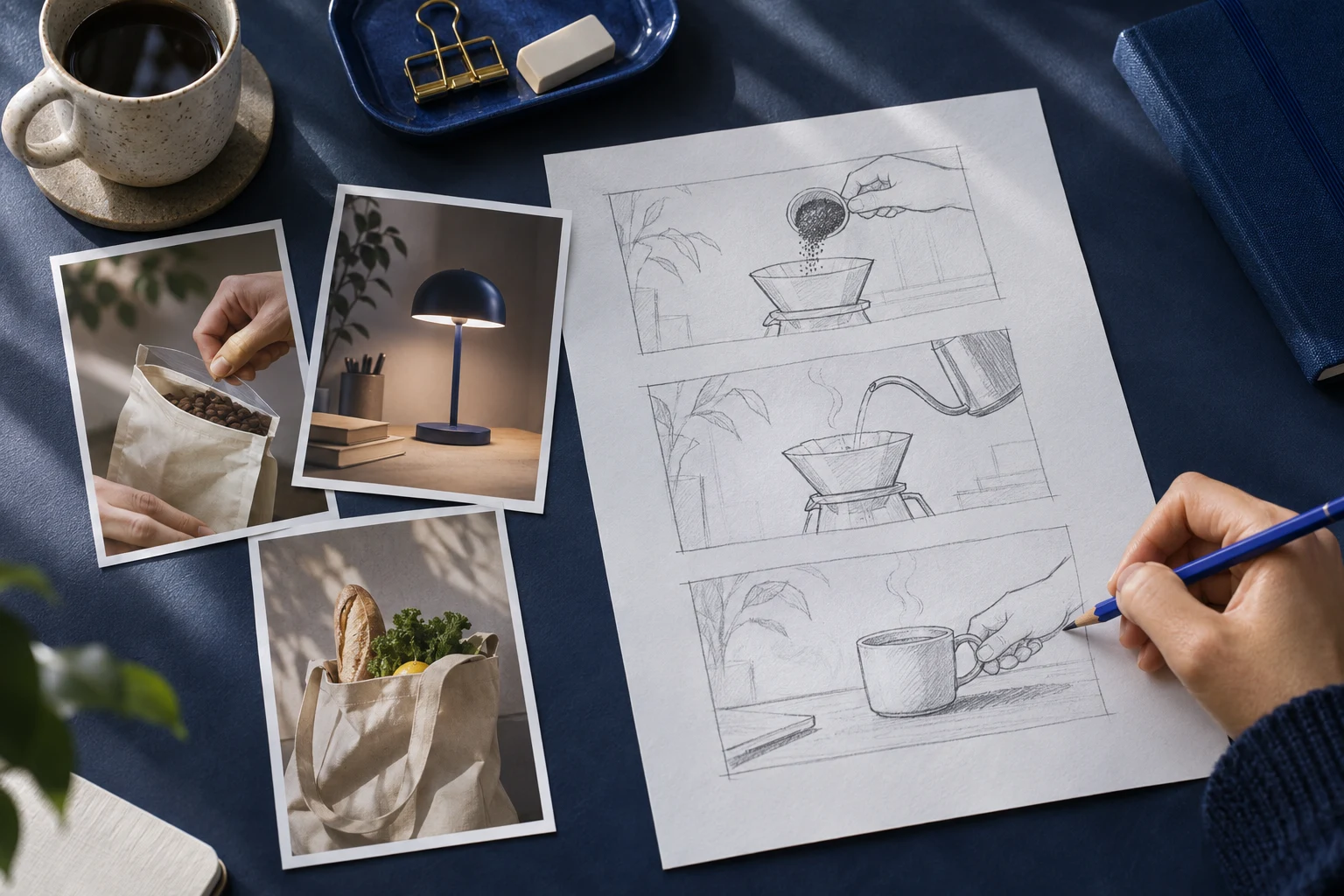
Start with a question your next Reel should answer
Competitor ad research gives you a place to start when the content calendar is empty. Look at how other brands introduce a problem, demonstrate a product and ask for the next step. Then write a brief using your own customer insight and evidence.
The useful output is a filming or writing decision. “Show the result before explaining the process” gives you something to make. “This brand has nice videos” leaves you with the same blank page.
This guide follows one example: a small coffee brand planning Instagram Reels for people who make coffee at home. The brand and briefs below are hypothetical. They illustrate the method, without claiming results from a campaign.
1. Choose brands solving the same customer problem
Start with three to five businesses your customer might consider. Include a direct competitor and an adjacent product serving the same need. For the coffee brand, that could mean another roaster, a coffee subscription and a maker of home brewing equipment.
Write down the question behind the search: How do these brands help someone feel confident about making better coffee at home? That question is more useful than collecting every ad with a coffee cup in it.
Keep the market and audience in view. An offer built around next-day delivery in one country may tell you little about a business shipping internationally. A brand with an established following can also leave out context your first-time viewer needs.
Set a stopping point before you browse. Ten relevant examples are enough for a first research session. This is an operating suggestion, not a benchmark for what a successful campaign requires.
2. Find their Facebook and Instagram ads
Use the Meta Ad Library to search for an advertiser and inspect the ads available for your selected market. Start with the brand name, then narrow the results using the filters available in the interface. Note the date and market you checked so you can revisit the same context.
If you research ads regularly, Skaler adds filters for details such as platform, language and media type, plus tools for saving ads into boards with tags and notes. That gives you an organized reference set when you return to write the next batch.
Be precise about what you are looking at. A video ad shown on Facebook is a creative reference, but that alone does not establish that it ran as an Instagram Reel. Record the platforms shown and treat the intended organic Reel as a separate execution.
3. Record the decisions behind each ad
Save the reference link and a few specific notes. A folder full of videos is difficult to use if you cannot remember what caught your attention.
For each example, capture the following:
- Context
- Brand, reference URL or ad ID, market, platform and date observed.
- Opening
- The first image and the exact promise or problem introduced.
- Demonstration
- What the viewer sees the product do, and when that evidence appears.
- Objection
- The hesitation the video addresses, such as effort, fit, cost or complexity.
- Next step
- What the viewer is asked to do, and where that action leads.
- Your adaptation
- One decision you could test using your own product, footage and claims.
Separate observation from interpretation. “The first frame shows a finished cup” is visible. “This opening sells more subscriptions” would require performance evidence you do not have.
Watch once without sound and check whether the product and demonstration remain understandable. Then listen to the spoken explanation. Record what each layer contributes instead of assuming every visual choice caused the ad’s results.
4. Turn a reference into an original brief
Write the useful pattern in plain language, then set the reference aside. “Demonstrate one action before describing the features” is portable. Another brand’s script, customer testimonial and footage belong to that brand.
Suppose a reference introduces an unfamiliar kitchen tool by showing a complete task in close-up. Our coffee brand can borrow that teaching approach while filming its own brewing process. The subject, words, product evidence and final video all come from the coffee brand.
Hypothetical coffee brand brief
Show the grind before explaining the bag
- Audience
- Someone who owns a French press and is unsure which coffee to order.
- Opening
- Two close-up piles of coffee grounds. On-screen text: “Buying coffee for a French press? Check the grind.”
- Demonstration
- Show the brand’s actual grind options and the option it recommends for that brewing method.
- Evidence
- Film the real grounds, product label and preparation. Check the recommendation against the brand’s brewing guidance.
- Close
- “Save this for your next coffee order.”
The brief now answers what to film, who it helps and which facts need checking. It does not require a claim that this grind guarantees a better cup.
Keep third-party references for research. Use footage and music you have permission to publish, and obtain permission before reusing someone else’s creative assets. Public visibility does not make an ad available for reuse.
5. Build a small batch around different customer questions
One research session should produce a few specific briefs. For the same coffee brand, a first batch might look like this:
| Customer question | Reel to make | Evidence to prepare |
|---|---|---|
| Which grind should I choose? | Show the available grounds beside the brewing equipment they suit. | Real grind samples and the brand’s brewing guidance. |
| How much effort is a subscription? | Walk through the actual delivery frequency and account controls. | A current recording of the subscription flow and verified terms. |
| What arrives in the first order? | Unpack a real order and show the label and contents clearly. | The package currently shipped to that market, with accurate quantities. |
The videos share an audience but answer different questions. That makes this a content exploration, rather than a controlled test of three hooks. If you want to compare openings, keep the body and offer stable and use the short-form hook testing guide to document the comparison.
A paid ad reference may end with a discount or a purchase button. An organic Reel needs a close that fits what the viewer just learned. A brewing tip might earn a save; a product demonstration might invite a profile visit. Choose the action before you write the closing line.
6. Make the Reel with your own product evidence
Choose the format after you know what the viewer needs to see. A real product action calls for footage of that action. A short explanation may work as a text story or a carousel. A funny observation only needs a meme treatment when the joke helps the message.
Prolifik can draft short-form content from your website and brand context, with formats including hook and demo, text stories and image carousels. Review the drafts against your brief, check product claims and visuals, then choose what to schedule to Instagram Reels, TikTok, YouTube Shorts or X.
Keep the research notes beside the production brief so the reason behind each creative survives review. Compare the draft with the original customer question before you approve it.
If the idea depends on an exact product action, use a genuine recording rather than a generated approximation. Keep any detailed editing in an editor suited to the job. The Prolifik Reels workflow explains the available creation formats and publishing path.
7. Use your own posts to decide what to make next
Before publishing, write down the response you want to learn about. For the grind explanation, saves and relevant follow-up questions might matter. For the subscription walkthrough, profile visits or attributable site actions may be more useful.
Record the available metrics with the date range, post age and definition shown in the platform. Compare posts on the same account under reasonably similar conditions. Keep paid and organic results separate, and do not compare a seven-day result with another post’s lifetime total.
Use repeated observations to refine the next brief. If viewers ask where to find the grind selector, show that step sooner in the next video. If a demonstration is hard to follow without sound, revise the framing or captions. A quiet first post does not establish that the idea failed, and one popular Reel does not prove a repeatable formula.
For your next session, choose one customer question, collect a small set of relevant references and finish one original brief before you keep browsing. That is enough research to start making something useful.
From brief to first draft
Make a Reel from your own brand context
Explore Prolifik’s creation formats, review each draft and choose what to publish.
Explore the Reels workflow