
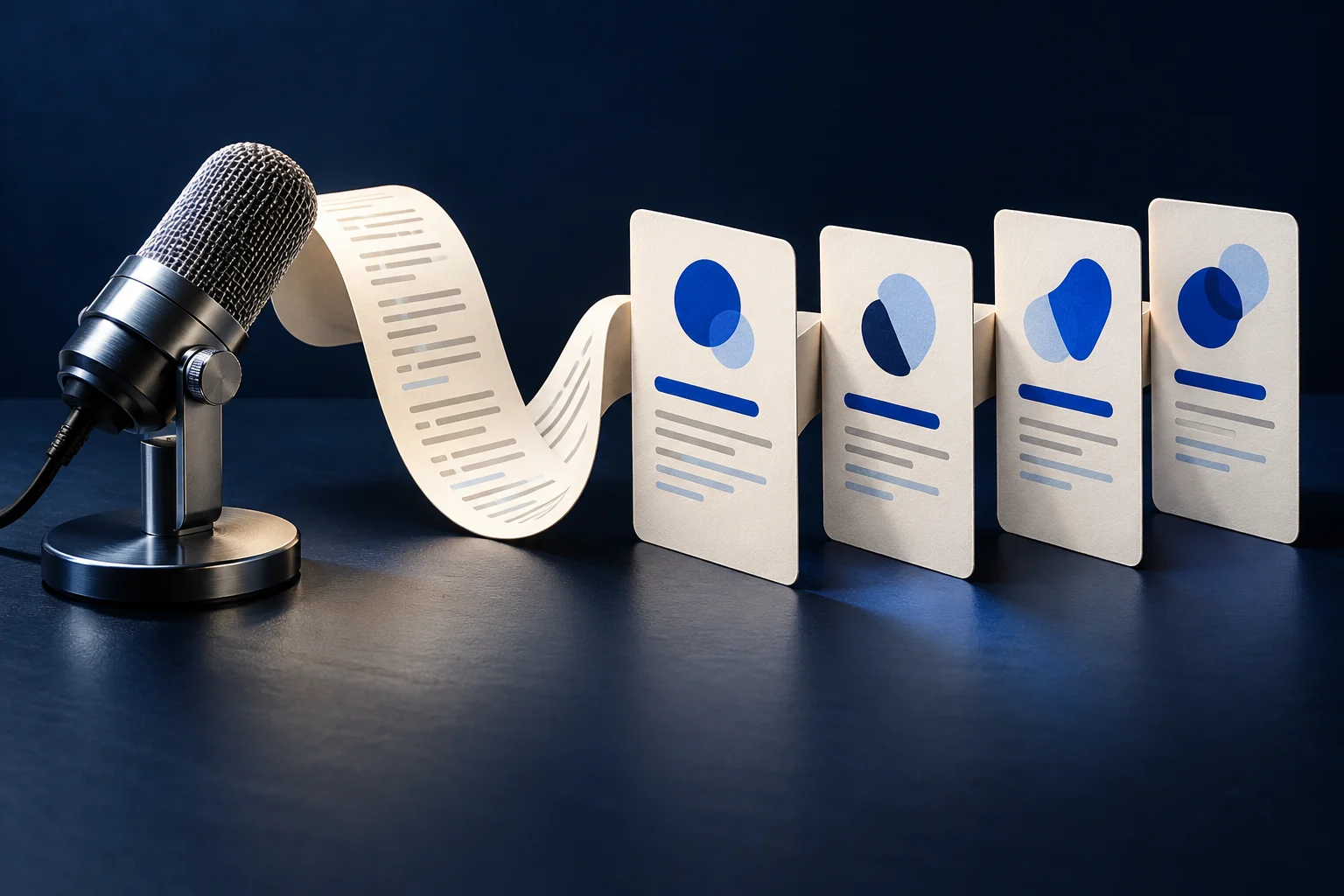
A transcript gives you source language, not a finished carousel. Choose one answer, keep its qualification, and decide which words remain a quotation and which become your editorial explanation.
Spoken answers often repeat themselves or rely on the interviewer's question. Removing that material can improve a slide. Removing the condition that makes the answer true changes the source.
Keep the recording and timecodes beside the transcript while you work. A text-only summary can hide a speaker change, a visual reference or a correction made a few seconds later.
Select an answer with a useful internal structure
This original example uses a fictional founder interview about a scheduling app called MeetRibbon. The illustrative answer is:
“We ask a new team to open one booking window first. Otherwise they sometimes set up the whole month and only then notice that two people need different availability. For a shared team inbox, check who owns the booking before you invite everyone. Individual calendars can start more simply.”
That answer contains a starting action, a reason, a team-specific condition and an exception. A weak summary would reduce it to “Set up your calendar before inviting the team.” That loses the useful distinction.
Do not turn every interview answer into a deck. If the answer is mostly a reference to another screen or a repetition of a point already covered, choose a different source segment or keep it as supporting material.
The best source content to repurpose guide helps make that selection before production begins.
Mark quotation, summary and added example
Use three labels in the working document:
| Label | Meaning | How it appears publicly |
|---|---|---|
| Quote | Exact approved words from the speaker | Quotation marks and truthful attribution |
| Summary | Your shorter account of their meaning | Plain editorial copy, not a quote |
| Example | A new illustration you created | Clearly labeled illustrative material |
For MeetRibbon, “Individual calendars can start more simply” could remain an exact quote if its use is approved. “Start with one booking window” is a summary of the opening. A mock two-person availability diagram is an added example.
Do not combine them into a single attributed sentence. The speaker did not necessarily say the diagram's labels or endorse your new wording.
Build a five-panel answer
Here is a complete illustrative sequence:
- “Start with one booking window before you build the whole month.”
- “Why: a small first setup can reveal different availability needs.”
- “For a shared team inbox, decide who owns the booking.”
- “Individual calendars may need a simpler setup. Keep the team-specific advice in context.”
- “Try one real booking path, review it, then expand the setup.”
This is editorial summary copy based on the fictional answer, not a set of customer quotations. If publishing an actual interview-derived deck, retain the speaker's approval and attribution where required.
Notice that the qualification has its own panel. It is part of the explanation, not legal clutter to be hidden in the caption. If a short video version cannot display it clearly, simplify the other panels before removing it.
Return to the recording before approving copy
Check the sentence before and after the excerpt. The speaker may have corrected the product name, narrowed the use case or disagreed with the interviewer's premise.
Listen for who “we,” “they” and “it” refer to. A transcript may assign speakers incorrectly or omit a pause that changes the sentence's meaning. Verify product terms against current documentation, but do not silently rewrite a recorded historical statement into a current claim.
Adobe's transcript-linked editing documentation explains how text and timecodes can drive edits in a sequence. That mechanism is useful for locating source material. It does not establish editorial permission or prove that a summary preserves meaning.
The customer interview guide covers the same context check for clips. A carousel needs it even when no original footage appears in the output.
Design for a reader who did not hear the question
Name the task on the cover. Replace unexplained pronouns with accurate nouns in editorial summaries. Where the question is necessary, include a concise version and distinguish it from the answer.
Do not fill every panel with transcript text. One carefully chosen quotation can carry more authority than several dense screenshots of speech. Use your own explanation around it to orient the reader without pretending the speaker said more than they did.
For an owned written source instead, use the blog-to-carousel guide. The source rights and editing choices differ when the original language belongs to your own article rather than another person's recorded answer.
Create and review the actual output
With approved copy, use Prolifik's carousel workflow to produce the sequence. Current outputs can include slide images and video; inspect the appropriate version for the intended channel and delivery path.
Check panel order, attribution, line breaks and the last panel's next action. For video, read the whole answer at normal playback speed. For native slides, ensure each panel has enough context to survive a pause or screenshot without becoming a misleading quotation.
Keep the source map with the approved copy. When someone asks where a statement came from, the team should be able to answer with the recording and context rather than a generated summary.
Build the carousel from your approved copy
Choose the structure and delivery first, then review the actual panels and timing.
Explore Image CarouselFacts checked 2026-10-24. Worked examples are illustrative unless a real source is identified.
- Adobe: Text-Based Editing overview Checked 2026-10-24
- Prolifik MCP documentation Checked 2026-10-24